Last updated: Saturday, 5th September 2026
Iodine on a vegan diet isn’t too much trouble to find, but it does pay to be deliberate about it. Iodine is one of the few nutrients where both too little and too much of it can cause problems.
How much iodine do you need a day?
Adults in the UK need around 140 mcg of iodine a day (WHO recommends: 150 mcg). Most dietary iodine comes from animal foods, so this is genuinely a nutrient worth knowing your options for as a vegan.
Do vegans get enough iodine?
Vegans tend to get less iodine than meat and dairy eaters, but the picture is less dramatic than it sounds. A small 2003 study is often quoted for finding a high rate (80%) of deficiency among vegans, and while it flagged a real issue, it’s not telling the full story.
Another conclusion from the research was this: though vegans tend to have lower iodine intake and lower urinary iodine, their actual thyroid functions normally.
The exception tends to be people over-doing the seaweed supplements. The goal isn’t to overdo it, it’s simply to include one reliable source rather than leaving it to chance.
What are the signs of iodine deficiency?
Iodine deficiency can be quiet, but a few recognised signs are worth knowing:
- A goitre – a visible swelling at the front of the neck, where the thyroid gland enlarges
- Persistent tiredness
- Unexplained weight gain
- Feeling the cold more than usual
- Low mood
None of these prove much on their own, since they overlap with plenty of other things. If you think you might be low in iodine, the reliable route is a test through your GP rather than guesswork.
Seaweeds that are rich in iodine
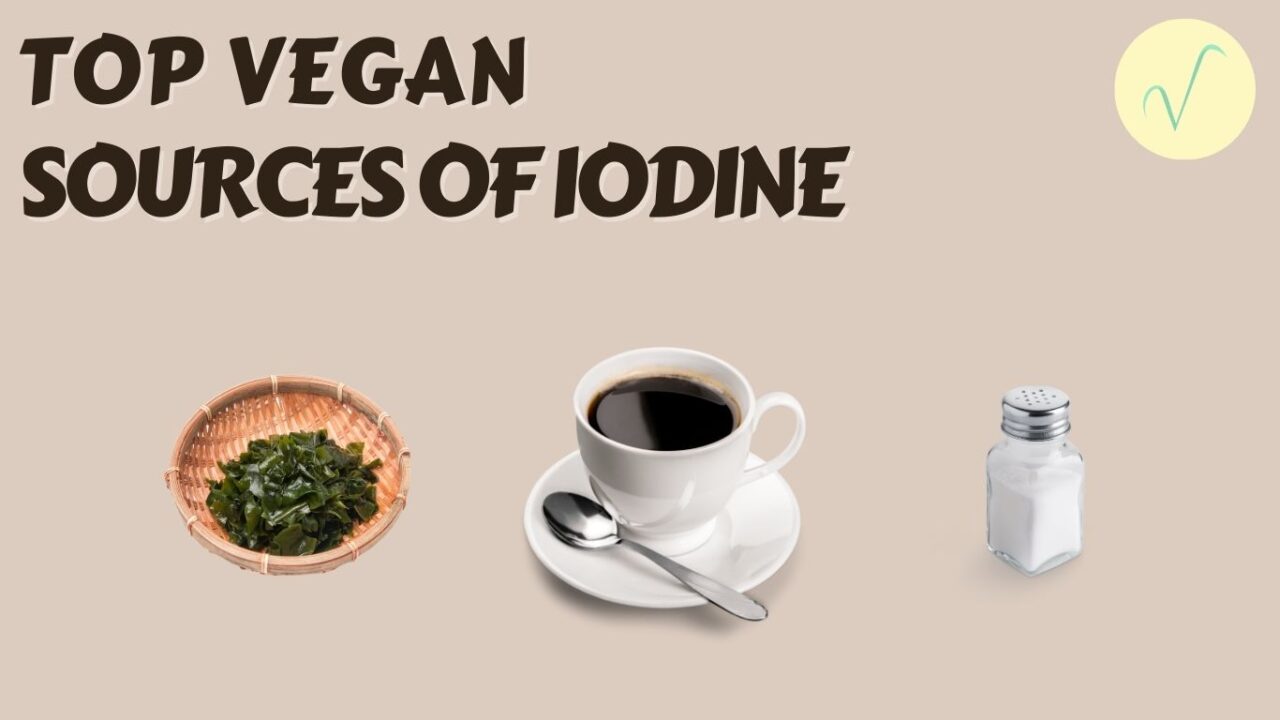
Seaweed is the most concentrated plant source of iodine there is, which is both its strength and its weakness. The iodine content in seaweed ranges from near-zero in some products to over 10,000 mcg in a single serving of others, varying by species, where it was sourced, and how it was processed.
Seaweeds that are rich in iodine
Seaweed is the most concentrated plant source of iodine there is, which is both its strength and its weakness.
The iodine content in seaweed ranges from near-zero in some products to over 10,000 mcg in a single serving of others, varying by species, where it was sourced, and how it was processed.
Nori
Nori, the thin, dark sheets used for sushi are the best accessible everyday seaweed for iodine.
Nori sits at the moderate, predictable end, at roughly 15 to 45 mcg per gram, so a standard sheet (3g) or two goes a long way towards your daily need without overshooting. It’s easy to snack on as is or crumbled over rice, noodles, and salads.
Wakame
Wakame is the tender seaweed in miso soup and the umph behind the infamous wakame salad.
Wakame provides more iodine than nori and is a reasonable source, but as levels vary depending on where it’s grown, treat it as an occasional treat rather than a daily habit.

Kombu (kelp)
Kombu, a type of kelp, is very iodine-dense, commonly in the range of 1,200 to 3,000 mcg per gram, some being much higher. That is much bigger than the daily requirement in a small amount, regularly overdoing it can disrupt the thyroid just as much as being deficient.
Use it sparingly to flavour a broth, but don’t use kelp as a daily iodine supplement. For the same reason, the NHS advises against kelp supplements, which may also contain arsenic.
If you do cook with kombu, it’s good to know that boiling it draws out so much of the iodine that the broth would still be high in it even if you remove the piece. Genuinely use kelp in moderation.

Irish moss (sea moss)
A reliable go-to, Irish moss (seamoss) is usually blended into a gel and stirred into smoothies. Irish moss is rich in iodine, ranging from 4 to 100mcg of iodine per gram, so keep servings modest, around a couple of tablespoons of gel a day as a rule of thumb.
A general note on seaweed: It’s best to avoid hijiki, which can contain high levels of inorganic arsenic, go for the more predictable options like nori over the extreme sources like kelp.

Iodine-fortified plant milks
When a plant milk is fortified in iodine, it typically provides around 25 to 50 mcg per 100 ml, similar to cow’s milk, so a normal daily amount makes a decent dent into your daily consumption.
That said, not every plant milk is fortified with iodine. Some brands leave it out because it has a metallic aftertaste, and many organic vegan milk options aren’t fortified at all.
So it’s best to check the label, look for added iodine and pick a brand that provides it if this is your main source.
Iodised salt
Iodised salt is another simple, low-risk source of iodine, and yes, it’s vegan. The amount you need depends on where you’re based: iodised salt in the US has roughly 45 mcg per gram, whereas in the UK fortification is far lower and much less common, and a lot of British table salt isn’t iodised at all.
Always check the label, because you can’t assume salt is iodised, and don’t start eating more salt purely for the iodine, everything in moderation. Treat it as a small contributor, not the main source.
Other minor vegan sources of iodine
A few plant-based foods chip in smaller amounts of iodine, and they’re worth including as part of a balanced diet.
- Lima beans bring folate, iron, magnesium, and a modest amount of iodine, at roughly 15mcg per cooked cup.
- Potatoes carry some iodine (1 mcg/100g), mostly in the skin, so bake or roast them whole rather than peeling to keep it. This entirely depends on the quality of the soil, not if it’s organic.
- Kale, watercress, and green beans contribute trace amounts but are also worth eating for plenty of other reasons.
Vegan iodine sources at a glance
Here’s the everyday vegan food sources of iodine, with high-caution ones flagged.
| Source | Iodine | Notes |
|---|---|---|
| Fortified plant milk | ~25 to 50 mcg per 100 ml | The safe everyday backbone. Check it’s actually fortified |
| Nori | ~15 to 45 mcg per gram | Best everyday seaweed; predictable. A standard 3g sheet or two goes a long way |
| Iodised salt | ~45 mcg per gram (US); far lower and less common in the UK | Check the label; don’t add salt just for this |
| Lima beans | ~15 mcg per cooked cup (about 10% of your daily need) | Minor source |
| Potatoes (with skin) | ~1 mcg per 100g, mostly in the skin | Minor source; depends on the soil |
| Kombu / kelp | ~1,200 to 3,000+ mcg per gram | High caution: use sparingly to flavour a broth, never as a daily source |
| Irish moss (sea moss) | ~4 to 100 mcg per gram | High caution: high and variable; limit to about 2 tbsp of gel a day |
For reference, UK adults need around 140 mcg of iodine a day, so the everyday sources at the top are the ones to build a habit around, with the last two kept occasional.
Should vegans take an iodine supplement?
An iodine supplement is a sensible, reliable option for vegans, especially if you don’t regularly eat seaweed or at least iodised salt. It’s key to choose the right kind: a supplement providing around 150 mcg of iodine as potassium iodide or potassium iodate, is better than kelp-based supplements, whose dose is inconsistent from batch to batch and may contain arsenic.
The other rule of thumb is not to double up. Iodine is one nutrient where more is not better, so if you already eat plenty of fortified foods or you’ve had a seaweed-heavy day, you don’t also need to take the supplement that day. Moderation is key here.
Can you have too much iodine?
Yes, you can easily exceed your daily iodine intake and it’s the part most people overlook. Too much iodine can disrupt the thyroid as much as too little can, and the usual culprit is kelp or high-dose seaweed supplements rather than ordinary food consumption
The practical iodine limit for adults is not to exceed 500 mcg a day from supplements in the UK (the US tolerable upper limit is higher, at 1,100 mcg), not to be confused with the daily recommended amount.
Hitting your daily iodine from fortified milk, a little iodised salt, or a 150 mcg supplement leaves you comfortably clear of that. Regularly reaching for kombu is not recommended to get your daily dose in.
Iodine in pregnancy and who’s most at risk
Iodine needs to rise when pregnant and breastfeeding, to roughly 200 mcg a day, as it’s an essential nutrient for a baby’s brain development. If you’re pregnant, breastfeeding, or planning to be, this is worth focusing on: A supplement and fortified milk may be the safest route, and is of course worth raising with your GP or midwife.
Pregnant and breastfeeding women, teenage girls, and anyone who avoids both dairy and fish, could use a deliberate overhaul in their daily iodine intake. None of this is cause for concern, just a reminder to make sure you don’t neglect it.
Are meat and dairy better sources of iodine?
Meat and dairy are not better sources of iodine than vegan food, just different, and less controllable than people assume.
Dairy is a leading iodine source for meat and dairy eaters, but is variable as it depends on the cattle’s feed and the season, so an omnivore’s intake also fluctuates. Meat and milk aren’t the consistent iodine sources they’re often thought to be.
Vegans and iodine
A vegan simply needs one deliberate reliable source of iodine, whether that’s fortified plant milk, a little iodised salt, or a 150 mcg supplement, iodine which is arguably easier to track than an omnivore relying on milk as their main source. Take this info with a pinch of (iodised) salt, and grab one of these reliable sources on your weekly shop.